

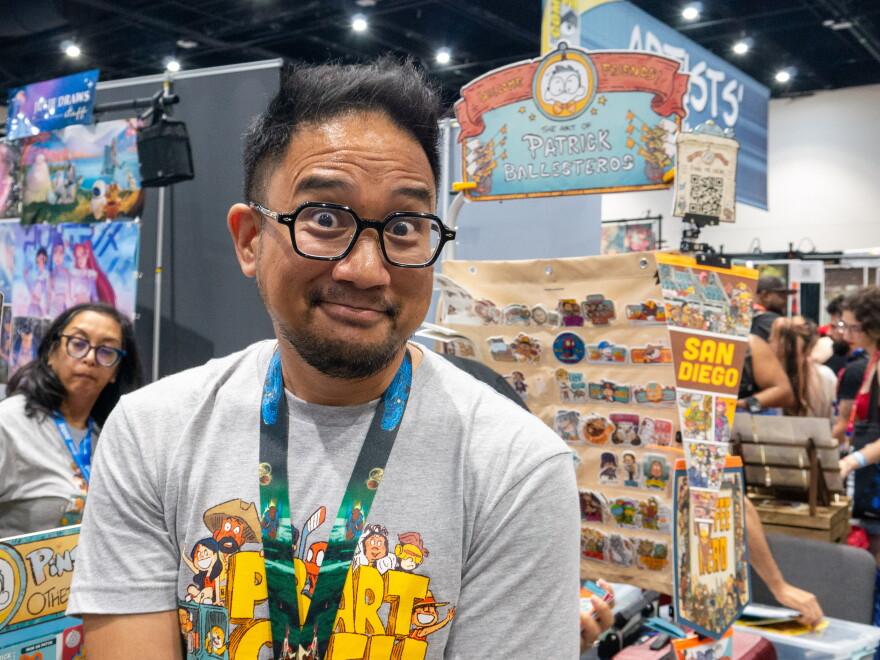
Nicole Jalandoni stood in the staggered line that ran through Artists’ Alley on Thursday, patiently waiting to buy fan art created by San Diego artist Patrick Ballesteros.
While in line, she looked over laminated images of his designs, displayed like a restaurant menu featuring Ballesteros’ signature stickers, prints, patches and more.

She’d followed his work for years, but this was the first time she had braved the line.
“And how long have you been waiting so far?” I asked.
“So far, I have no idea,” Jalandoni replied. “I've just been locked in looking at this,” she said, referring to the menu. “But probably like 15 to 20 minutes.”
But she doesn’t mind the wait. Ballesteros’ art resonates with her personally.
“It's very nostalgic,” Jalandoni said. “A lot of these are like my favorite animes since I was growing up and then the puns. They're funny, if you get it.”
Ballesteros is known near and far for his unique illustrations that blend pop culture, comics and Filipino culture. And in recent years, he’s not alone in this culturally rooted approach to fan art.
Stickers, prints, clothing and bookmarks that reimagine beloved characters can be found throughout Artists’ Alley and the Small Press section.
On the opposite side of the convention floor, illustrator Genevieve Santos draws a crowd of her own to her stationery company, Le Petit Elefant. She has a flock of followers who purchase her designs that integrate her Filipino identity and BTS fandom.

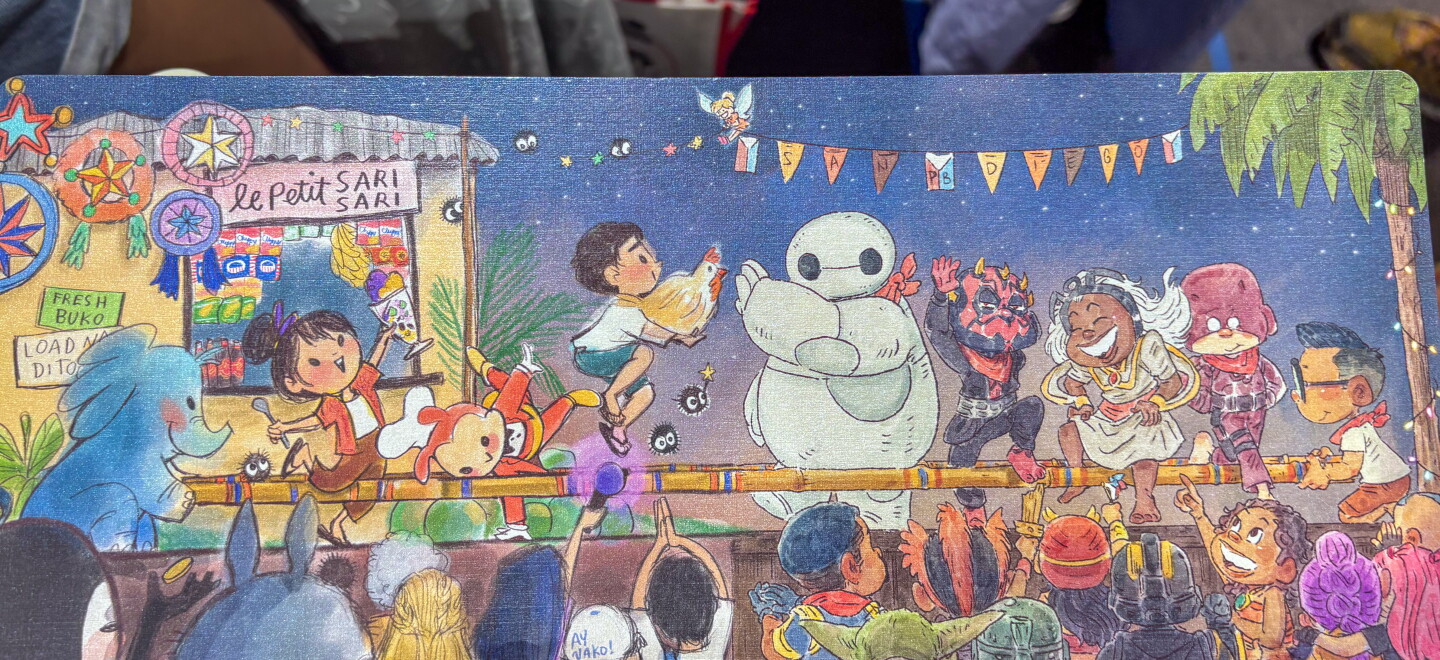
And this year, Santos’ and Ballesteros’ booths share something in common: a vivid print they created together called “Close-Open, Close-Open.” Ballesteros came up with the idea to honor a phrase many people in the Filipino community hear from elders growing up.
“That's what they say to you when you're a baby,” Ballesteros said. “But also the double meaning is the close-open of the sticks.”
The bamboo sticks he’s referring to play a major role in the traditional, precolonial Filipino dance tinikling, which involves at least two people tapping bamboo poles on the ground and clapping them together while one or more dancers step in and out between the poles. Beloved animated characters like Baymax from “Big Hero 6” dance and jump as the sticks underfoot tap out a rhythm.
There’s another connection to Filipino culture through the sari-sari store, a neighborhood shop that is a signature design from Santos. Sari-sari stores typically sell everyday household items, snacks, fruit and drinks. She sees fan art as a unique way for people to connect with characters.

“I love fan art because people kind of imbue their own personal stories with like these beloved well-known characters,” Santos said. “I think that's why people really love fan art. Being able to see their favorite characters like Totoro or even just like an elephant playing like tinikling is kind of special.”
Stephen Yapit bought the print for his wife at Santos’ booth. Yapit is drawn to the representation of Filipino culture he has seen grow at the convention.
“Specifically for Filipinos, it's definitely worth us here representing for our community, and it's fun seeing everyone's art, everyone's creative processes,” Yapit said.

Ballesteros said Filipino animators have played an important role in the animation industry throughout history, but they haven’t always received recognition. Santos and Ballesteros feel the Filipino community and culture are having a moment right now at Comic-Con and beyond.
Ballesteros pointed to the upcoming DreamWorks film “Forgotten Island,” which draws inspiration from Filipino folklore and features a star-studded Filipino voice cast.
Santos also noted that ube-flavored drinks and treats have become more common at major chains like Starbucks.
“People are becoming not necessarily aware of it, but more accustomed to it,” Ballesteros said. “That gateway to come into the culture is through food and through entertainment and stuff like that. But I think it's only going to get bigger.”
Santos said the representation of Filipino artists and designs marks a big shift.
“I have a lot of friends now who are Filipino artists, who are leaning into it and it's so wonderful to see just more representation, more voices,” Santos said.
Ballesteros and Santos say this collaboration won't be the last. Both intend to continue creating pieces that connect and celebrate their community.


