







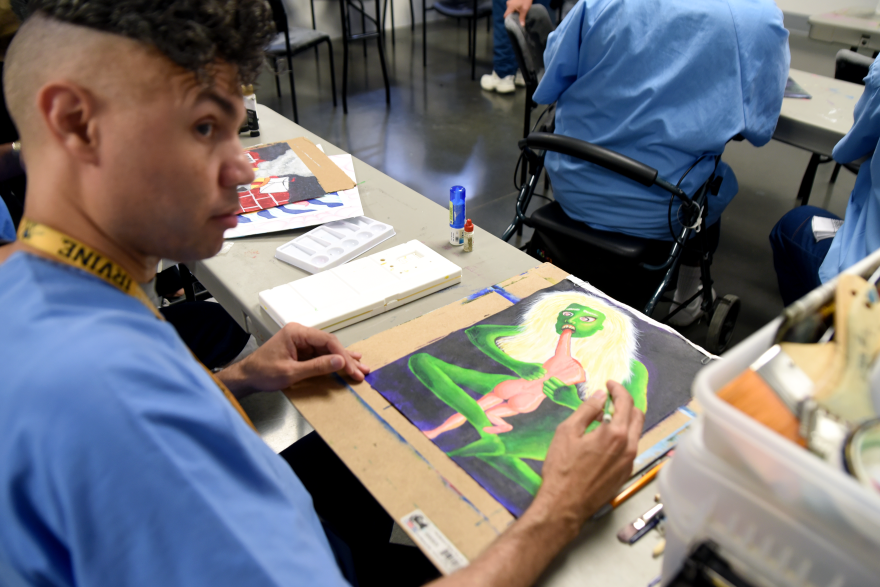


At Richard J. Donovan State Correctional Facility in San Diego, a weekly art class offers something rare: a space to create, connect and feel human.
In this episode, we visit Project PAINT, an arts organization bringing art education to people incarcerated in California prisons. We meet students serving life sentences who have found unexpected purpose in painting, including one former student who now returns to the prison as an instructor. Their stories reveal how creativity can help people manage anger, grief and isolation, while opening doors to education, self-expression and a sense of belonging. But access to art supplies and classes is limited, and the question of whether prison arts programs reduce recidivism remains difficult to answer.
Through conversations with artists, educators and researchers, we examine the promise of creative rehabilitation and why making art can matter even when freedom is out of reach.


Guests:
- Travis aka Juice, Project PAINT student at Donovan
- Morgan Mandalay, Project PAINT instructor
- Ruben Radillo, Project PAINT instructor
- Ian, Project PAINT student at Donovan
- John R. Whitman, author of "Prisons of Creativity: Artist Innovation During Incarceration"
- Laura Pecenco, Project PAINT founder
- Gwen, Project PAINT student at Donovan
Sources:
- Recidivism of Prisoners Released in 24 States in 2008: A 10-Year Follow-Up Period (Leonardo Antenangeli, PhD and Matthew R. Durose, Bureau of Justice Statistics, 2021)
- Incarcerated Students Now Eligible for Federal Pell Grants (California Department of Corrections and Rehabilitation, 2023)
- Tim Robbins's Prison Improv Classes Make Inmates Less Likely to Re-Offend (Mickey Rapkin, New York Magazine, 2016)
- Revisioning Recidivism: Going Beyond the Stats (Rehabilitation Through Arts, 2025)
- The Data Behind Prison Reform (Jinmook Kang, Marcelo Agudo, Josephine Wonsun Hahn, The Brennan Center for Justice, 2026)
- Here's What Pride Was Like in a California Prison (Daniel X. Cohen, Prison Journalism Project, 2026)


Julia Dixon Evans: There are about 780 people incarcerated in the E-yard at the Richard J. Donovan State Correctional Facility in San Diego. One of them is Travis Carter. Everyone calls him Juice. He's been in prison since 2009.
Juice: I was 28. I was a raver, so like part of that culture is like the, there was a lot of drugs involved, and that's where I sold drugs, basically.
Juice: Money disappeared. I wanted to find out who it was, and I resorted to asking in the most worst way possible where my money was, using violence and guns, and it was, it was bad. I, I, I said, "Look, I, I will kill these two people if you other two don't go get, you know, X amount of money from your family." That's what it ended...
Juice: It took two days to like evolve into that, but then that's what it was, 'cause I just wanted to get the money back. And of course, it went sideways. Nobody was, nobody was killed. You know, obviously, it's the worst thing I ever did in my life. And I knew that these people, like the vi- the victims, they were, you know, friends and acquaintances of mine, and I just really, really should, should have never, never done that.
Juice: I was charged with kidnap for ransom, assault with a firearm false imprisonment. The kidnap for ransoms are life sentences, straight up. Automatic life. Yep, 209. Yep, kidnap for ransom, they give you life. I didn't know that at the time. So when I came to prison, I was like a level four, so that's like super hardcore, like never leave the cell.
Juice: I was in the same cell with one other guy for like a whole year. I never came out. Can you imagine how boring that is? There were times when I first came to prison that I really didn't give much of a damn about anything. and I was kind of up for whatever, right? Doing drugs, selling drugs, 'cause that's what I did on the streets.
Juice: I w- you know, I sold ecstasy and LSD and shroom, all that kind of crap, right? They don't sell those things here, but there's a, there's a lot of drugs. The most popular one is Spice, synthetic weed, some analog or something. So I was a hop, skip, and a jump away from doing that again. So I decided to fill my time by learning how to do art, comic book style art.
Juice: I was stuck on this. I'd be, I'd be doing art like five, six hours a day, and it kept me out of, out of the mix. It did. And I sold my art. That was part of the way I made money. So like art fed me. Art stopped me from doing other nefarious activities that would've generated money. Like, it definitely helped me stay out of trouble.
Evans: Juice was painting when he told us this story. He attends weekly classes with Project PAINT, a San Diego based organization that brings art education inside prisons.
Juice: You know, when you're doing art, it's like a constant series of decisions that you're making. how do I do this? So should ... You know? And I just like feeling locked in.
Juice: It makes me feel, like, powerful, I, I guess. Like, like I'm some kind of, like, super brain. And when I'm in that zone, and, and art puts me in that zone more than anything else, I almost feel invincible. I feel like I could do anything. and it, it, it brings a sense of, of contentment. I enjoy, I enjoy it. I, I can't even
Juice: It's hard to describe sometimes
Evans: For Juice, art became a way to make different choices about how he spent his time and what he wanted his life to become. That included finishing a sociology degree from UC Irvine while incarcerated.
Juice: I was the first one in the family to get a, a college degree. I'm also, I think, the first to get a life sentence, so, you know, I'm kind of trying to cancel it out a little bit, you know?
Juice: but I, it, to me, it all sort of started with art.
Evans: In prison, any kind of positive transformation like Juice's is not all that common. Across American prisons, the 10-year recidivism rate is 60%, meaning most people who are released from prison end up going back, and whether someone reoffends has a lot to do with how they spend their time while they're in prison.
Evans: At Donovan, we found that for many, drawing or painting just a few hours a week was the difference between life and death, and for some, helped open the door to freedom.
Juice: It helped keep me alive i- in a time when I definitely ... I could have gone either way. Yeah. And art, man, I mean, it's powerful
Evans: From KPBS Public Media, this is The Finest, a podcast about the people, art, and movements redefining culture in San Diego. I'm Julia Dixon Evans.
Evans: Before coming to Donovan, producer Anthony and I sent very detailed lists of exactly what we planned to bring.
Prison worker: Suspension microphone holder? That's- OK. Then AAA batteries?
Evans: Yeah. And the guards check our list against everything we have on us. It's tedious, but we actually have it easy compared with Morgan Mandalay from Project PAINT.
Evans: His list includes 20 erasers, 105 paint brushes, and 101 colored pencils.
Prison worker: 101, OK. Like, one to one donations? Yeah.
Evans: And they have to count everything.
Prison worker: Two, four, six, eight, 10, 12, 14,
Evans: 16. Morgan leads classes here and other yards at Donovan four times a week, so this is an almost daily routine for him.
Prison worker: Almost done, halfway.
Prison worker: Plastic paint mixer.
Evans: After the equipment inspection, we pass through a series of high security gates before stepping into E-yard.
Ruben Radillo: Nice good old ER
Evans: Ruben Radio was once a student in the Project PAINT class incarcerated in this very yard, and now he's back as an instructor.
Ruben Radillo: Do you have memories out here? You know I do. I have a lot of memories. Most of them were pretty good.
Evans: The yard has a large gravel courtyard. That evening, several people were out walking on a path around the perimeter.
Evans: There are huge murals on nearly every wall out here depicting San Diego scenes in vivid detail, the coastline, Balboa Park, and the missions.
Ruben Radillo: So let me tell you the history of this, right? OK. I was here when it first started. That tree right there, and that's where the mural began.
Anthony: Oh, you st- you did that tree?
Ruben Radillo: Yeah, we did that tree.
Evans: Ruben honed his artistic skills in the Project PAINT classes, which have been running since 2013.
Anthony: You really liked taking the classes when you were here?
Ruben Radillo: I, I, I liked taking the class, and I liked, loved coming back.
Evans: How, how does it feel, like, walking in here every time?
Ruben Radillo: In the first time it was kind of nervous and because, well, I, I wasn't sure if the guys were gonna accept me because everybody takes things different.
Ruben Radillo: Maybe some people were gonna think, like, "Oh, he thinks he's better than us." But surprisingly everybody accepted me, and, and they said, "Thank you for coming back and giving us hope." You know?
Evans: That hope is a big deal for Ruben. He received a life sentence in his 20s, and when he first arrived in prison, he said he didn't have many reasons to feel hopeful himself.
Ruben Radillo: So I remember one commissioner, her name was Ms. Loland, and she was pretty blunt with me. She told me, "We're never gonna parole you. You're, you're a gang member, and you're a manipulator." So, you know, I, I, I remember going back to my cell crying. I was like, "Damn, so that means I'm never gonna get out.
Ruben Radillo: I'm gonna die here. She told me." Yeah. And so I decided to, you know, just give up hope and be the best thug, criminal that I could be in here.
Evans: Eventually, there was a different voice in Ruben's life. A mental health professional at the prison not only told him that he could have a chance at parole but also introduced him to several classes available inside, like the Project PAINT class.
Ruben Radillo: At first, I was like, "What am I gonna do with art?" I, I, I didn't, I didn't want to do art out when I got out. You know? Like, like, where, where is that gonna get me? But it's, it's, it saved my life.
Evans: Today, Ruben is out on parole and works as a professional tattoo artist using the creative skills he developed here.
Ruben Radillo: I'm living proof that, that art has an impact on, on, on keeping one safe and, and sound mentally and, and expressively. Art, helps you not come back.
Evans: He wants to give those still in the yard hope that they can make it out, too. He has faith in them.
Ruben Radillo: They're worth giving a second chance to, and, and, and they will be good neighbors, good citizens, and well, good human beings
Laura PP: I'll sign in over here. OK. That would be great.
Evans: Inside the E Yard building, it kinda looks like a high school. White fluorescent lights, big hallways, people milling about and chatting. The smells of cafeteria food waft through the halls.
Ian (artist): You got a two year now?
Evans: And then we reach our classroom, where Morgan gets the session underway.
Morgan: OK, so, if you haven't already, you can grab your work from the back. It's a free work day, so ...
Evans: The students gather their supplies, and their works in progress.
Ian (artist): So the project was, we took like, different things from, like, various famous paintings. So I think it was, like, the Death of Saint Augustine, and then there was one with a creepy old lady, and with, like, a metal mask on, so we just kinda-
Evans: Ian's finishing up his painting in the front row.
Evans: Beside him is a cute black lab wearing a service animal in training vest.
Ian (artist): That's Kyla. She's about two years old. Yeah, you can pet her. She's good. I'm
Anthony: excited.
Ian (artist): Good girl, mama. Yeah, she's a lucky pup. So how long have you
Anthony: had her for?
Ian (artist): I've had her for about six months now. And then I've had her for another six-
Evans: Ian trains dogs for veterans and families with disabilities.
Evans: That's his job in here. Kyla sits obediently at his feet while he works. Ian's painting is of an otherworldly scene of two masked figures standing in an idyllic field. It's creative, skillful, and extremely detailed, and his work is especially impressive considering the fact that he, like most of the students we talked to, had never really painted before taking this class.
Ian (artist): Definitely get to learn how to how to work with paint. So, mixing colors and stuff, and it's, Yeah, it's just, right now I'm just making a mess, but it'll, it'll all come together.
Evans: But mastering an art form isn't the main goal for a lot of the students in the class.
Ian (artist): It's like a healing experience. It's therapeutic.
Ian (artist): Really, more than anything, it's, like, really relaxing. Yeah, the dog's pretty much keeping me alive, so yeah.
Anthony: Like, this class is pretty important to you.
Ian (artist): Yeah. I've been, I got a life sentence, and I've been in for a little over half my life now. I lost my wife about two years ago, so it's like, the last couple years I've been doing this, and it's, it, it helps a lot.
Ian (artist): So it makes a huge difference. Saved my life. Why
Anthony: do you think it's been so important, like, thera- so therapeutic?
Ian (artist): It takes a lot of, like, time and care to, like, create something, something good especially. So it's a rewarding experience, really just that, being able to create something instead of making a mess of things.
John R. Whitman: These are acts of creation that don't harm anybody else, but they can be so fulfilling to that individual who's doing time, and they can benefit society if there's a product of, as a result.
Evans: John Whitman is the author of the book Prisons of Creativity: Artist Innovation During Incarceration. He also runs the Creative Prisons project based out of Chicago.
Evans: He spent much of his career as a professor of business. What got him interested in prison arts programs was realizing just how much of our country's talent and innovation was confined in prisons.
John R. Whitman: It turns out that there is extraordinary creativity that's locked up in prisons in the US. But if you look at the, prison population in aggregate, we are close to two million people imprisoned in the United States, which is equivalent to the fifth-largest city in the country.
John R. Whitman: Among the, the developed countries, the so-called OECD countries, there's no country that comes close to the US in terms of the number of people per 100,000 that are behind bars.
Evans: Not only can prison arts programs unlock the creativity in this huge population, but they also work against what John sees as the failures of our incarceration system, a system that largely does nothing to help or harness the potential of people who are incarcerated.
John R. Whitman: There's so much evidence that we are not doing anything to truly rehabilitate people who are put into prisons in the United States. and the degree of so-called recidivism is just off the charts. It's way, way too high.
Evans: But there is evidence that prison arts programs can actually lead to rehabilitation and lower rates of recidivism.
Evans: What role can art play in changing that? Based on our conversations with John and Donovan, it starts simple, with a feeling of relief or joy in the moment, a few hours a week to feel something like happiness.
John R. Whitman: As a matter of fact, many people who engage in these types of activities speak to how it's the, the only means they have to feel free in their environment.
John R. Whitman: I guess it's a form of escape for them.
Evans: In the classroom, we hear stories like this over and over again.
PP Student: Art sets me free. I can only speak for myself. It frees your spirit. It frees everything but your body.
John R. Whitman: And it's good. It, like, helps with the stress and all that, you know, makes you
PP Student: forget about being here in prison.
PP Student: Feels great. Probably, like, the best part of the week.
PP Student: I don't want to sit in here and not have anything beautiful to look at, so I create art so that I have something.
Evans: For some, that feeling is enough to keep them coming back and as they practice, they begin to develop skills and confidence. Project PAINT founder, Laura Pachenko, says a big part of the organization's mission is sharing the students' work with the outside world.
Laura PP: It builds self-confidence. It helps with family ties, you know, being able to send pieces out or share something on our website with them, or have them come to an exhibition that we do. You know, public events are also very important to us. We do a lot of publications, zines, things like that, exhibitions.
Juice: I could say that I'm a published artist because they have published some of my works in magazines.
PP Student: I have art on the cover of issue five of Iron City Magazine. Reuben right here has his art on issue four of Iron City Magazine.
Anthony: Are you proud of that?
PP Student: I am. I'm super proud of it. To be the cover piece, to be selected for the cover is, is, like, super, super... I'm very proud of that
Evans: The peace and fulfillment people feel in the class and the confidence they get from sharing their work with the world, this starts to change their behavior.
John R. Whitman: There's evidence that when people, when people in prison engage in arts programs, there are fewer cases of acting out in prison. So this is actually good news for correctional officers.
Evans: But the big question is always: How does it impact recidivism? Can these programs make it less likely that people will reoffend and come right back to prison?
John R. Whitman: It has been shown that putting people in prison by itself does nothing to reduce the recidivism rate. But once you start adding educational programs and give people the opportunity to learn something, you do get a significant drop in recidivism. Now, the challenge for arts programs as being a subset of these educational programs is how can you prove, how can you get hard evidence that shows that by taking an art program, you're less likely to recidivate?
John R. Whitman: There are data, though, that show that by engaging in art programs, people build a sense of confidence that encourages them to sign up for other educational programs. So you look at the art programs as a kind of gateway program to move people into higher levels of education. And, and there we see indeed, we see drops in recidivism rates.
Evans: As of 2023, people incarcerated in the US are now eligible for Pell Grants, but in California, just under 14% are enrolled in college classes. Among the students in our Project PAINT class, that number was much higher. Laura says their own survey found that 65% of their students had enrolled in college classes.
Evans: So many of the people we talked to had taken classes or were about to start. Some even finished their degrees.
Yeah, I'm going to college. I got a class coming up in a couple weeks.
Juice: Just graduated like a m- a little over a month ago, and once again, I'm here back with the art.
Evans: The connection between education and lower recidivism is well established, but John says more research is needed to understand whether participating in arts programs is directly linked to the likelihood someone will return to prison.
Evans: However, there are smaller studies of individual programs that have shown promising results. A theater program in California called The Actors Gang saw an 11% reoffending rate. The Rehabilitation through Arts program on the East Coast says it sees a recidivism rate of less than 5%. Remember, the nationwide recidivism rate is over 50%.
Evans: Despite these impressive results, people who want to do art in prison still face a lot of resistance
John R. Whitman: The obstacles are incredible and, and, and some people have the experience of correctional officers who, who confiscate their work and tear it up, or they lose it in the process of being transferred from one institution to another.
Evans: Coming up, getting access to the supplies and space to create isn't always easy. Stay with us
Evans: Project PAINT classes have room for 25 students. The classes fill up fast. Wait lists can be months long and without additional funding to expand its operation, the organization is limited in how many classes they can offer in each correctional facility they serve. But beyond that, students are having trouble getting the materials they need
Ian (artist): A lot of the prisons are really restrictive on what we can and can't have.
Ian (artist): So for some of us, getting to come here is the only chance we'll ever get to even do this stuff.
Evans: Longtime Project PAINT student Gwen said that the yard used to have much better access to high-quality paint.
PP Student: When we first opened up the yard back in 2016, we were able to order from Dick Blick Art Supplies.
PP Student: and then couple years later, they discontinued our access to handicraft items. So I've been kind of dwindling away my supplies slowly over the last seven years.
Evans: Without their own paints, it's tough for most students to work on their paintings in their cells whenever they want. They have to wait for the few hours a week that Project PAINT comes in, along with the supplies the instructors bring.
Juice: I need the supplies. I'm not gonna lie. Like, I do. I wait till everyone leaves, and I scrape their paint off and put it in here. Like, it's, it's like that. Like, I, I'm like Oscar the Grouch, try it like secondhand paint. So I'm, I'm, I'm reduced to that, but that's OK. I gotta do that.
Evans: Juice and Gwen see the restrictions as part of a larger tension inside prison, the competing priorities of punishment and rehabilitation.
Evans: And they say that obstacles to rehabilitation come not only from the prison system but also from the other people they're incarcerated alongside.
PP Student: There's a lot of competing mindsets in prison. Not everybody is at the same place in their rehabilitation or even desiring to be in a place of rehabilitation.
PP Student: Some people choose to stay in the same lifestyle that got them in prison to begin with. Selfishness uncaring attitudes towards other people, drug use, gang activity.
Evans: But for people trying to make different choices, the classes here offer a refuge. Like,
PP Student: we've come in here to get away from all of that.
PP Student: For those of us who are trying to do better having a place to go where, where we can create art is, is very refreshing.
Evans: E-yard was designed specifically to be this way, an experimental programming-focused facility, but it takes buy-in, and Gwen says not everyone's on board. But among some of the people who live there, E-yard has developed a distinct culture over the years, a place with art, music, and nerdy tabletop games.
Juice: Magic: The Gathering Pathfinder, Dungeons & Dragons. There's a band called Birds Aren't Real that's on, on this yard. they, they got a real good guitarist, I'll give, I'll give them that.
Evans: For the people we met on eYard, the priority is taking classes, getting an education, and focusing on the future. Juice just finished his degree in sociology, and Gwen is working toward one too
PP Student: We have people of all types in here,
John R. Whitman: I guess.
PP Student: Different racial backgrounds, lifestyles. As a member of the the queer community, it's, it's a very welcoming class. I get along with everybody in here no matter what their background
Evans: Gwen is a trans woman incarcerated in a men's prison. During our visit, her classmates used her pronouns without hesitation.
Evans: And just a few weeks earlier, E-Yard had held a Pride Month event. Ruben, the instructor, has known her for years.
Ruben Radillo: When she, she took her time and did frameworks for all our art pieces. I was, I was telling her how, you know, she's been dedicated and consistently dedicated all these years, and I'm, I'm, and I'm really proud of her.
Evans: Gwen has been incarcerated for most of her life, since she was a teenager.
PP Student: I had a lot of anger issues when I was a child, and I let them get the better of me. And I ended up murdering a couple of people. Both of my victims were family members. And It's a very difficult emotional thing for me to talk about.
PP Student: It took me quite a, quite a few years to to get my, my f- anger kind of controlled to the point where I don't blow up. I would punch walls. I would punch, you know, doors. I broke my hands a couple times, and decided after the last time that I broke my hand that I need, I needed some help. If I feel angry, I can always come in and paint an angry picture or you know, something that helps me get some of that out.
PP Student: I go back to the parole board next April. I've been incarcerated for 27 years now since I was 16, and I'm 43, and hopefully this will be my second and final time going to the parole board.
Evans: We ask Gwen if art classes like this make a difference in the parole process.
PP Student: Absolutely. the parole board, last time I went, they, they wanted to know what what groups, what programs I've taken that were, that were really beneficial and why they were beneficial, and this was one of the, the most beneficial that, that I've taken since I've been incarcerated.
PP Student: It, it's absolutely healing. I don't know if I would have as much of a goal in my life if it wasn't for this class specifically. if I'm allowed to parole, I'd like to come back in and work with Project PAINT helping other people discover their own talents.
Evans: While John waits for more research to quantify the impacts of prison arts programs, what might be the most important benefit is harder to measure. Art helps people who are behind bars feel human.
John R. Whitman: If you look at prison as being a place where people are denied liberty because of something that they've done, the one way you can be sure that they can exercise their humanity is through acts of creation.
John R. Whitman: Engaging in creativity or engaging in art is a human right. It's just a way for people to be human.
PP Student: Took me away from the, the negative, but, and did, it showed me something positive and showed that I could contribute to society and that I could do better and be better. Honestly, it's like a peace of mind.
PP Student: You know, it's, art's part of life. I don't know, like drawing and it lasts forever, so it's beautiful. So that's what attracts me. I'm leaving a, a print, basically.
Evans: Our class's instructor, Morgan, had his own experience with the criminal justice system. He was tried as an adult at 15. He remembers prosecutors back then who told him he wouldn't amount to anything. But he had a few other adults in his life who believed in him. That's who he tries to be for the people in his Project PAINT classes now.
Morgan: Part of that is also about, like, getting them to tap into who they already are, and to recognize that they are treated like human beings in this space in a space that doesn't often do that for you. And, you know, speaking again of my, my, my experience, like, a big part of what I had to hold onto wasn't the moments of somebody telling me, like, what I couldn't do anymore, the, or the bad in me, but was the people who had told me, like, "No, you're already a better person, and you need to do that.
Morgan: You need to lean into that person." Mm-hmm. I still look back at, like, these letters from, you know, different programs that I did and stuff like that at that age, and, and they still make me tear up, you know? Like, they ha- Knowing that those people had faith in me, even at a time when other people didn't, was was, yeah, was really important, and allows you to step into that sort of, like, better future for yourself.
Evans: Morgan eventually discovered painting, and went to art school. And painting, he's found, is all about problem-solving.
Morgan: Painting is a cr- is that, like is a, like, response to what you've done more than it is about getting it right the first time.
Evans: Mm. Did you mean to do a metaphor?
Morgan: Shh. Don't tell anybody.
Morgan: yeah, that to me is the beauty of painting, is you make a mistake, and then you work to resolve it, and you make a mistake, and you work to resolve it, and, and slowly you come a, become accustomed to the fact that, like, you can resolve certain things. It doesn't make it go away, and that's why I, I'll sh- I often show, like, the, this Velázquez equestrian portrait, where you can see where he put the hoof, where it was, like, supposed to go.
Morgan: And, and for me, it was, like, my first experience seeing a painting in person at the ... Like, I was like, "Oh, wait. It's mistakes, and you resolve those mistakes."
Evans: Laura, Project PAINT's founder, has spent the last 13 years leading arts programs at three different yards at Donovan, as well as other institutions.
Evans: She's also a professor of sociology, and is well-versed on the data about how arts programs can chip away at recidivism and conflicts in prisons. But it's her firsthand experiences in these rooms that keep her coming back every day.
Laura PP: I think that art is healing, and I think that you can absolutely see that.
Laura PP: you know, I'm sure as you're talking with everyone in class tonight, you can see, right? That it's, like, it's just evident. You know, I can study a lot of things, right, from the outside, but actually being in here and getting to work with people, make art with people, you know, it makes all the difference.
Evans: And for students like Ruben, now a teacher himself, programs like this changed how he saw himself, and that changed everything.
Ruben Radillo: This program saved my life, you know, especially Laura. I don't know, like, the, the, she, she's hu- she humanizes us. Like, "Oh, OK, this is how, this is how I'm supp-," you know, be treated as a human being, so I love it.
Ruben Radillo: You know, I love coming back. I love giving hope, and, and I love encouraging everybody, you know?
Evans: Thank you to Morgan Mandalay, Laura Pachenko, Ruben Rodillo, John Whitman, Lieutenant Cottrell, and the staff at Donovan State Prison. And special thanks to Juice, Gwen, Ian, and everyone we talked to in the Project PAINT class at E Yard. And thank you to KPBS video journalist Carolyn Karelis. Look out for video of our visit to Donovan on our website soon.
Evans: And thank you so much for listening. If this episode resonated with you, please subscribe, leave a rating or comment. It makes a real difference and helps stories like these reach more people. The Finest is a production of KPBS Public Media in San Diego. I'm your host, Julia Dixon Evans. Our producer is Anthony Wallace, who also composed the score.
Evans: Ben Redlawsk is our technical producer, and Chrissy Nguyen is our editor.
From KPBS Public Media, The Finest is a podcast about the people, art and movements redefining culture in San Diego. Listen to it wherever you get your podcasts or click the play button at the top of this page and subscribe to the show on Apple Podcasts, Spotify, Amazon Music, Pocket Casts, Pandora, YouTube or wherever you get your podcasts.
Have feedback or a story idea? We'd love to hear from you. Email us at thefinest@kpbs.org and let us know what you think.