








Every new technology changes the way art is made. Generative AI is pushing those questions into the spotlight faster than many artists expected. As with other big leaps in industry and technology throughout history, it's not always as simple as being for or against it.
From animation studios and independent creators to Comic-Con panels and university labs, we follow the people navigating one of the creative world's biggest turning points. Some choose not to use AI. Others see it as another tool. Many fall somewhere in between. Their stories reveal that the real conflict isn't simply humans versus machines. It's about preserving imagination, protecting artists and deciding what role technology should play in creative work.
As AI becomes more capable, one question keeps surfacing: What makes a piece of art feel unmistakably human?
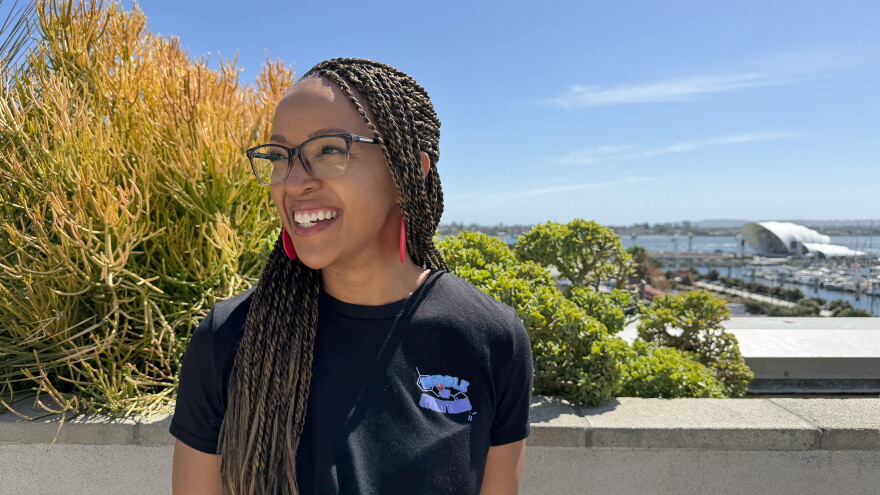


Guests:
- Jeaux Janovsky, animator
- Marc Biagi, voice actor and professor of information technology at San Diego City College
- Ben Zhao, designer of Glaze and Nightshade and professor of computer science at the University of Chicago
- Taylor Johnson, founder of San Diego animation and creative house Mortis Studio
- Camille Jones, co-creator of "Middle of Everything" and a former CDC epidemiology expert
- Darby Vickers, philosophy professor at University of San Diego and advisory member of the Animation Guild AI Task Force
- Connie He, director of "Dear Upstairs Neighbors"
- Geoffrey Long, professor of emerging technology and design at Miami University in Ohio
- Attendees of San Diego Comic-Con 2026
Sources:
- Critical Crossroads: The Impact of Generative AI and the Importance of Protecting the Animation Workforce (Animation Guild, 2024)
- Future Unscripted: The Impact of Generative Artificial Intelligence on Entertainment Industry Jobs (Animation Guild, 2024)
- Marvel faces backlash over AI-generated opening credits (Adrian Horton, The Guardian, 2023)
- Amazon MGM Studios Embraces AI: Greenlights Three Series for Prime Video Under New ‘GenAI Creators’ Fund’ (Todd Spangler, Variety, 2026)
- Netflix will launch an AI animation studio — but 51% of people aren’t in favor of a future with generative AI content in it (Danni Santana, Moneywise, 2026)
- Death Threats, Doxxing and AI: How Animator Jorge Gutiérrez Killed His Own Show in 36 Hours (Clayton Davis, Variety, 2026)
- The Legend of John Henry: Talcott, WV (National Park Service)
- How Professional Visual Artists are Negotiating Generative AI in the Workplace (Harry H. Jiang, Jordan Taylor, William Agnew, Carnegie Mellon University, 2026)
- “iScream” Music Video (Deaton Chris Anthony, Mortis Studio, 2022)
- How animators and AI researchers made ‘Dear Upstairs Neighbors’ (Cassidy Curtis, Sarah Rumbley, News from Google, 2026)
Episode 48: Animation and AI Transcript
Julia Dixon Evans: Generative AI is coming for animation. Actually, it's already here. In one survey, three-quarters of animation studios say they're early adopters of AI. Marvel used it for the opening credits of the show "Secret Invasion." Amazon and Netflix are actively investing in their own generative AI animation studios. And all of this had the people we spoke to at Comic-Con this year feeling a little uneasy.
Comic-Con attendee: I would say I'm an unabashed AI hater at this point.
Comic-Con attendee: I think anything with the animation, though, it feels just sort of wrong, you know?
Comic-Con attendee: I don't think it belongs anywhere in art, because art is for and by people. I don't wanna see what a computer thinks. I want what a person thinks.
Comic-Con attendee: Generative AI is always 100% theft, in my opinion.
Evans: But not everyone sees AI as the villain. Some artists and experts we spoke with told us this may be, after all, another technological leap, like the computer or even the camera and printing press, that could simply expand what's creatively possible for artists.
Marc Biagi: You know, a lot of people hated when we had our first computer graphics programs, right? Saying, that's not real art. You're not really drawing. And yet people have created great works of art, but because they know art.
Geoffery Long: Each of those major inflection points in technological evolution, there is a backlash, right? There is a nasty like, oh, no. What's happening? We're all going to die. It's coming for us. And unless you approach it with a kind of creative curiosity to figure out what kind of a realistic threat it is, but also what kind of an opportunity it is.
Evans: So which is it? Can it be both a villain and a hero? And can a machine actually make art? And these questions really matter because for so many people we met, animation is not just another industry.
Comic-Con attendee: I think animation is a great part of our culture.
Comic-Con attendee: Your imagination is your only limitation.
Jeaux Janovsky: Cartoons are fun. They keep you young at heart.
Evans: That last voice is Jeaux Janovsky. He's an animator we talked to after a panel about the history of animation. From inside the industry, he's seen how intense the public backlash to AI can be. It happened to his friend, Jorge Gutierrez, who directed the popular animated movie, "The Book of Life." In May, Jorge announced he made a deal with Amazon for a new series.
Janovsky: But it was to utilize AI, and the backlash on that was just swift and, you know, terrible.
Evans: Almost immediately, his home address was posted online.
Janovsky: People were giving him death threats and, you know, threatening his family and stuff like that.
Evans: Jorge said he'd originally accepted the deal because he knew an AI reckoning was coming for the industry, and he wanted artists, not tech companies, to be on the front lines of that change and shape how AI would be used. But the nuances of his decision seemed to go unnoticed, and just 36 hours after the deal was announced…
Janovsky: He backed out of it.
Evans: In an interview, he told Variety he learned right away that, quote, "This is a black-and-white issue. You're pro or you're anti." But many of the artists we met didn't fit neatly into either camp, including Jeaux.
Janovsky: I'm very anti-AI, but I mean I've done work where the producer uses the AI as like a springboard. I took their AI stuff and then did my designs.
Evans: So the images started as AI, then Jeaux brought them to life with his own drawings.
Janovsky: I feel like you can still see, like, the human touch that's retained in that.
Evans: The story of human versus machine isn't new.
Janovsky: It's kind of like that folk tale, right? John Henry versus the machine, right?
Evans: John Henry was a steel driver. He hammered steel drills into rock. When the steam-powered drill came along, he decided to challenge it to a competition.
Janovsky: He's like, I can beat that machine, and, you know, he did.
Evans: John Henry won the battle, but died immediately after his triumph from exhaustion.
We'll hear from artists also fighting AI with everything they have, and others embracing it. We'll explore stolen artwork, lost jobs, new creative tools and whether a machine can ever create something that feels truly human.
Comic-Con attendee: But this is kind of like a whole new level of like, yes, it's, it's animated, it's visual, but is it art?
Janovsky: I mean, like, the genie's out of the bottle already, right?
Evans: From KPBS Public Media, this is The Finest, a podcast about the people, art and movements redefining culture in San Diego. I'm Julia Dixon Evans.
[Theme Music]
Evans: AI as a whole doesn't have a great approval rating right now. Only 10% of respondents in a recent PEW survey said they were more excited about it than they were concerned. And one of the biggest concerns is for jobs. And the jobs it's threatening aren't the ones we once expected it to.
Biagi: AI is supposed to be, you know, our robots doing the dishes, and taking care of the laundry and stuff like that. I'd be down with that, you know? But, you know, as far as coming for creatives first, that seems to be kind of where they did it in some ways.
Evans: This is San Diego voice actor Mark Biagi. We asked him about some of his roles in video games and animation, and he slipped into character on the spot.
Biagi: Vector the Crocodile from "Sonic Heroes," and Boris the Elephant. Boris is kind of like this. He's kind of like a geeky guy, and he's an elephant. He's pink and he's kind of short. He talks a lot, and he's really smart.
Evans: In real life, Mark is also a professor of information technology at San Diego City College. We caught him just after he spoke on a panel about AI. He's seen work dry up for people in all corners of the animation industry, and people having to leave the field.
Biagi: And it is all related to AI, because these smaller companies don't have big budgets, so they're going with something that isn't costing them as much money.
Evans: In a recent survey, 54% of visual artists said AI has already diminished their income, and AI isn't just replacing human artists. It's training on their work, often without any permission or compensation.
Biagi: They're basically mining skills, mining intelligence, mining human capability, and wanting to sell it back to us.
Evans: And Mark is worried this could happen to his voice.
Biagi: Twenty seconds, a sample of 20 seconds of your voice could be used to train a model to make you say anything. What's to stop someone who is trying to profit off of no work and plugging something into a system from training on your voice? We have to be very cautious. It's a scary world out there.
Evans: Generative AI is feeding on artists' work without consent, and using it to train their models or even explicitly imitate them. Producer Anthony caught up with one person who's made it his life's mission to fight against that. And he's using one of the oldest tricks out there, a digital Trojan horse.
Ben Zhao: Think of it like basically a poison pill inside your art
Evans: That's Ben Zhao, professor of computer science at University of Chicago. He's been an academic researcher for 22 years. Much of that time, he was focused on protecting people from surveillance. Then, a Zoom call in late 2022 changed his career forever.
Zhao: Some artists actually proactively reached out to us because they had seen some of our prior security work.
Evans: In a town hall meeting with artists, they started talking about new AI models that were becoming really common online.
Zhao: There were hundreds of thousands of these lightweight models that were being shared online, and each of them had a human artist's name attached to it.
Evans: Basically, they were AI bots that mimicked particular artists' styles. So let's say you like the work of Jeaux, the animator we heard from earlier. You could find a Jeaux AI, put in a prompt, and it spits out whatever you want in his style.
Zhao: Other people will take it, produce images with your name on it and then share it online, which is even more harmful because then, you know, these artists, when they Google their name, literally would see not their own work, but, like, AI-generated images mimicking their work. And not only they would see it, but their potential future employers, you know, movie studios, gaming companies, book publishers, would see all this as representative of who they are as an artist. And in many cases, a lot of these contracts would disappear because they say, Oh, I mean, this is crap, right? Because this is low quality, mid-tier stuff, and we don't want any of that.
Evans: In the town hall, the artists told Ben about…
Zhao: …their health insurance expiring, their inability to support their family now because of what was happening to them. So yeah, I mean, the human side of it hit hard. It was very jarring. And I think that night we were like, OK, this is something that is obviously a real injustice, and it was something that we could do something about.
Evans: That meeting transformed Ben's lab overnight. Since then, they focused on protecting people from AI, and their big weapon in that fight is something called Glaze. When artists run their work through Glaze, it basically applies pixel level changes to the art that mess with any AI that tries to use it. His poison pill. No human can see a difference in the art before and after Glaze modifies it.
Zhao: But AI models that train on the protected version or the Glazed version, see or perceive a very, very different version of art style. And so when they try to mimic someone who's had their art protected with Glaze, they basically get it entirely wrong. So you could try to mimic, you know, Monet and get something like a Jackson Pollock.
Evans: Glaze has been a huge hit with artists.
Zhao: To date, I think last I checked, there had been over 10 or somewhere around maybe 11 million downloads across 170 countries.
Evans: His team also has a similar tool, Nightshade.
Zhao: Nightshade changes the composition, Glaze changes the style.
Evans: Glaze is designed to protect individual artists' work. Nightshade works on a collective action scale, and could be a big problem for AI models.
Zhao: If you ingest enough Nightshaded images on the same topic, let's say dragons or cats or dogs or whatever, it'll convince the models that, for example, cats should have four tires and a giant hubcap. Or a giant hood that looks like a 1970s Chevy or, you know, a handbag should in fact have whipped cream on top with a fork sitting on a plate. And so these things confuse models, and if you do it enough, our research has shown that it actually breaks the models from the inside out. It acts as a deterrent that, you know, if these models continue to sort of train without consent they're gonna have internal issues inside their models.
Anthony Wallace: Do you see yourself as kind of like a resistance fighter or something? A punk figure?
Zhao: I think I've been called everything from a guerrilla fighter to a Don Quixote. But I think of it as just we're doing academic research with a purpose.
Evans: Ben's not only working on Glaze and Nightshade, he's also testifying in class action lawsuits, and advocating for legislation to protect artists. He's up against some of the biggest and most powerful companies in the world. But for Ben, art is something worth fighting for.
Zhao: You know, we wanna help people. There's so much that's wrong in the world today and human creatives honestly are some of the best of us in terms of just what humanity is able to offer that other things can't. So we wanna preserve creativity, and this is the best way we know how.
Evans: His work can disrupt it, but AI's momentum feels impossible to stop. And with layoffs at big studios, lost opportunities for artists and even art schools shutting down, Ben sees the damage is already being done.
Zhao: It's a struggle. I think human creativity will survive, but it will be diminished in some sense. So that's, I think that's the real damage, and that's the real pain right now.
Evans: So what are artists to do, especially artists who need to make a living? Many that we talk to are using AI themselves, at least in selective ways. And while they might be worried about it on a large scale, the fact is that using AI tools in animation can be a huge advantage. That's because animation is notoriously one of the most labor-intensive art forms.
Taylor Johnson: It's extremely hard and time-consuming, especially the way I do it. It's like frame by frame. It takes forever.
Evans: This is Taylor Johnson, who runs Mortis Studio in San Diego.
Johnson: It is 10 years we've had this company now, and we make animations, music videos, documentaries, branding, pretty much anything you need creatively.
Evans: Taylor says every animation starts with a script and a storyboard. Then comes the painstaking frame-by-frame work.
Johnson: For something that's like, say, five seconds long, it might take me all day. And that's like not even coloring yet. That's just like the sketches. And then I'm like, OK, time to redraw it to make it look cleaner, start to color it. So five seconds could take up to three days.
Evans: AI could cut that time way, way down. He told us about a request he recently got from a client for an animated internal video. They had a small budget, and it was a pretty complex video.
Johnson: I was like, dude, that's a lot of work. I would have to hire like 3D designers and blah, blah.
Evans: The only way it'd make sense for him to take on the job is if he used AI.
Johnson: So took a stab at it. Came out OK. It still looks like crap. It looks like AI. But it was good enough for their internal kind of email blast that they were doing.
Evans: Meanwhile, he told us about a similarly complicated project where they did have the budget to create it by hand.
Johnson: So we did a music video for this guy, Deaton Chris Anthony, and it had three different styles of animation. We did the 2D. We hired another artist to do the claymation, and we hired an artist to do 3D. That video, with all three of us working on it simultaneously, probably took like a month and a half, two months. Whereas the kind of crappy AI thing I did for the internal brand took me about a week and a half, two weeks.
I have a hard time looking at anything someone makes on AI and thinking it's art. AI doesn't have a taste level, it just makes crap that looks OK. But artists have, and creators have a taste and understanding, like, this looks good, this doesn't. AI doesn't understand that.
Evans: Taylor loves doing those in-depth projects with custom animation and that critical human touch. But clients are increasingly expecting creators to be able to work more quickly and more cheaply, and Taylor has to keep up.
Johnson: Obviously, when there's a new technology, there's like this kind of, oh, I don't wanna touch it, but also I work in a technology business, so it's like, I have to learn this if I wanna stay alive. I look at, like, capitalism in the same way. It's like I'm not pro-capitalism. I think it's kind of a bad system, but I live in the capitalist society, and I have to live under its rules, otherwise I'll die.
Evans: When starting a new major project now, every animation creator has to decide how or whether to use AI. Coming up, we talk to one who did and one who didn't. And we ask a philosopher, can AI make art that's actually good? Stay with us.
[Music]
Evans: One of the animation creators we spoke to is pretty new to the field. Camille Jones is an expert in epidemiology.
Camille Jones: My colleagues and I, the co-producers, we actually are all scientists, and we all worked at the Centers for Disease Control and Prevention until 2025.
Evans: The idea for an animated show came during one of the bleakest moments in recent history in public health, when funding, jobs and life-saving programs were cut.
Jones: So Madhura Vachon is the woman who conceptualized this. And it was a dark, stormy night in 2025 dystopia, and she decided that this was not the world for us, and we need to create a new one. And so she stayed up till 4 a.m., wrote a script, and sent it to a group of friends saying, we need to make a show. And when that initial idea came, it was an illustration of the cells inside the body, and it was how do we find a way for people to easily understand how a vaccine works, to understand that it's not actually a terrifying, scary thing? There's been so much disinformation and fearmongering that have caused so much damage. How do we repair that?
Evans: Madhura assembled a team of public health experts, including Camille, and they developed the idea for "Middle of Everything." The show follows middle school kids on fantastical science adventures, of course, learning some things along the way. The team had a mission and an idea, but they knew next to nothing about animation.
Jones: Well, the first thing that surprised me was how expensive animation is.
Evans: They found an animation professor who enlisted his students to work on the project, and they launched a Kickstarter with a goal of $50,000.
Jones: We ended up getting that within two weeks. So now we're in full production of the pilot. And then we started to understand more about what it actually takes to produce this, and we are on an absolute shoestring budget.
Evans: Has your project used AI at all?
Jones: We've not. We've not. Our animators hand draw all of our work. It is fully like 10 fingers down to the paper of what we're creating. And from the beginning, we've received advice from any corner of a peanut gallery that says, you know, oh, it would be a whole lot easier if you just did this. But easier for who? Because to us, it's the hearts and the creation that is the point of it. I'm hoping, manifesting it, but, you know, a generation from now when "Middle of Everything" is a household name and kids are watching it, that they feel it as something that's been hand-created for them.
Evans: Despite this conviction, Camille's not totally anti-AI.
Jones: I think that the danger may be in if there's all or nothing thinking. As a scientist, a lot of my identity holds strong ideas loosely held. But I think that what is really important is to maintain your own value system and to know what is negotiable for you and what's not. So if something can be done faster, but you lose a piece of yourself in it, then was faster better?
Evans: She told us about a scene from the pilot that she doesn't think AI could have pulled off. It involves a middle school kid floating through a human body to learn how a vaccine works. Camille and the experts provided the science, and the animation team brought it to life.
Jones: And he becomes this microbe, and he's just this hilarious, adorable coif of red hair as a microbe alongside the immune cells. And then throughout the sequence, they add these very humorous things that were not involved in the script. So they were able to read between our literal lines and add a sense of humor that was very carefully done because it was between very serious topics.
Evans: For "Middle of Everything," maintaining a human touch is essential. In our time, Camille thinks it's the only way to communicate health and science ideas effectively. It's not enough to just have credentials and be an expert.
Jones: But I think what hasn't lost its power is the humanness and caring for people and wanting them to care for you. To me, successful public health requires teamwork and it requires equity. It requires to see and be seen. It's very love-based. And I think that that's really the mission of what we have to do if we are to really have these other concepts, these more complex concepts be understood.
Evans: For Camille, preserving the humanity in science communication and in creativity is essential. And where the AI technology is right now, it lacks this human touch.
Thinking about this gap between human and machine is what brought Darby Vickers into the AI conversation. She's a philosophy professor at University of San Diego.
Darby Vickers: I was giving a talk on Plato's theory of the soul and how that gives us justification for why we should save humanity's education. One of my friends, she came up to me and she's like, have you thought about the implications of your talk for artificial intelligence?
Evans: Plato's theory of the human soul involves three components.
Vickers: There's a reasoning part, there's an emotional part and there's a part that's, like, our desires like for food and drink and things like that. So you're just like, OK, AI seems to only have something like this reasoning part. It doesn't have these embodied features.
Evans: And this really matters when it comes to ethics.
Vickers: When we make ethical decisions, we're making them in part from our reasoning, but a lot of what it is is that we have instincts and emotions, and we feel empathy for others, and all of those are foundational to ethics.
Evans: Without its full human soul, AI tends to make all kinds of bizarre ethical decisions, which make headlines all the time. But Darby's also concerned with what AI's lack of emotions or empathy means for its use in creating art, especially animation. Her dad was an animation writer. She grew up around illustrators and voice actors, and in 2024, she was part of the Animation Guild's AI task force as they reported on AI's impacts on the industry.
Vickers: Animation in general, it is a very labor-intensive field. Now, there are ways of cutting significant costs by having artists build a much smaller number of views or settings or any of these sorts of things, and then getting AI to fill in the gaps.
Evans: Using AI like this in animation could impact some jobs but keep the essence of a human creation in the final product. The problem for Darby comes when it's used for more creative tasks.
Vickers: But it seems like the sort of, like, major design and writing and creation is something that we want to allow humans to do to express themselves, and then to enjoy the expression of others.
Evans: In general, Darby says that AI has a lot to offer in all kinds of fields, especially with doing mindless busy work that would free up our time.
Vickers: But I also think that we're not restricting AI to that sort of use, and in fact, people tend to be offloading the higher cognitive processes onto AI rather than engaging in them themselves.
Evans: And she's worried about what that cognitive offloading would mean for animation.
Vickers: Animation is a fantastic art form. It is something that is, can be highly creative and interesting, and you have the abilities to do all sorts of things that you couldn't do in live action. And I think that the sort of less we have the human touch in some of those artistic endeavors, the more hollow it's gonna feel in part because the way that AI is creating this material is by taking a synthesis of what humans have done before, and then spitting something else out. So there's not a lot of originality or great artistic expression when you're offloading these kinds of things onto an AI.
Evans: Do you think that it's possible that truly great art can be created by something that's not human?
Vickers: I don't know. It's a difficult question. And there's a part of me that thinks that the answer is no. I would think that art is something that is either human created or human modified, that creates an experience in the beholder, that there is a sort of, like, human expression within the object or text or whatever it is.
Evans: So we went looking for animation made with generative AI that still felt human. And one short film stood out to us, "Dear Upstairs Neighbors." And we wanted to know how it was pulled off.
Connie He: Hello, I'm Connie He. I'm the director for "Dear Upstairs Neighbors."
Evans: Connie's an animation artist with an impressive resume. She worked previously at Pixar on "Inside Out 2" and on the Netflix series "Love, Death + Robots."
He: There's so much things I love about animation. I think, first of all, I think animation is like a universal language that many people from different background, cultures, can all relate to.
Evans: When generative AI came around, Connie said people in the industry were panicking, and artists didn't know how it worked and how they could or should use it. She partnered with a group of artists and researchers from Google to try to figure out how artists could be in control of technology.
He: We're still at the very early day of exploring what is machine learning and what it can do. We need artists working actively with researchers. We need better information and better communication between those two worlds to really, like, make positive impact, so it will feel less of, the future will feel less dystopian.
Evans: So this newly assembled team, half artists, half researchers, started work on "Dear Upstairs Neighbors." For the visuals, they used a chaotic, abstract painting-inspired style that she said was difficult to pull off in animation. The way they used AI was to process artwork and ideas all created by their own hands. And in fact, they employed a huge human production team.
He: Everything animation is done by, like, human animators. And later, then where is AI, is we build a video to video pipeline to support this creative, the artistic, like, painterly style and animation, both 2D and 3D animation, and put them, married them together.
Evans: The six-minute animation short has no dialogue, but very effectively communicates a common human experience: trying to sleep, but your upstairs neighbors are causing a ruckus.
So what inspired the story?
He: My neighbors, of course. I was living, like, in an apartment during the pandemic, and, you know, at the time everybody's kind of trapped at home, and you start, like, hearing all those kind of crazy sounds. And a lot of the boards was done, like, 5 a.m. in the morning, and got waken up by, like, drillings and bangings and screamings. And I'm like, OK, this idea have to go somewhere. So, yeah, turned out to be a short films. Yeah.
Evans: Is there any negativity or blowback about it being using AI?
He: To be honest, I was worried about that a lot. Like, every time we go out to screenings I was anticipating a lot of, like, blowback. For now, we've been to Sundance and Tribeca, and SIGGRAPH. And to be honest, like, the reaction is better than I anticipated. After the film, there's, like, many people come to us saying, hey, you're doing something... You guys are doing something interesting. Like, I'm very skeptical about AI, but, like, from your film, I can see there's artistic choice made thoughtfully.
Evans: I'm wondering if you had any hesitancy before getting started about doing this project with AI, with Google, and, like if you had any doubts in the first place.
He: Yeah. That's a great question. I had a lot of doubt in the early days. I was like, oh, is, is... Am I doing the right thing? 'Cause, like, it has a lot of controversy, and it has a lot of issue related in many, many different area.
Evans: In her moment of doubt, Connie found a quote from Björk, the legendary Icelandic musician and an early adopter of technology in art.
He: She says that, like people always tell me, like, computer music doesn't have a soul. She's like, of course it doesn't have a soul. It's because we didn't put it into it. And that is kind of enlightenment moment for me. I was like, oh, yeah. Like, how, like how an artist can make a good work, you have to put your soul into it. Then it's good work.
Evans: And at Comic-Con, however people felt about AI, what they were really looking for was what Connie's talking about: a sense of soul in the work.
Comic-Con attendee: I think a part of the enjoyment is realizing that what I'm watching came from somebody's brain, somebody's imagination.
Comic-Con attendee: I wouldn't be a fan of something that wasn't, like, poured with love, you know?
Janovsky: Retain that human, that human touch
Evans: Special thanks to Jeaux Janovsky, Mark Biagi, Ben Zhao, Taylor Johnson, Camille Jones, Darby Vickers, Connie He, Geoffrey Long and all the animation fans we talked to at Comic-Con for their help with this episode.
And thank you so much for listening. If this episode resonated with you, please subscribe, leave a rating or comment. It makes a real difference and helps stories like these reach more people.
The Finest is a production of KPBS Public Media in San Diego. I'm your host, Julia Dixon Evans. Our producer is Anthony Wallace, who also composed the score. Ben Redlawsk is our engineer, and Chrissy Nguyen is our editor. This episode was written and researched by Anthony and me.
This transcript has been edited for clarity and conciseness.
From KPBS Public Media, The Finest is a podcast about the people, art and movements redefining culture in San Diego. Listen to it wherever you get your podcasts or click the play button at the top of this page and subscribe to the show on Apple Podcasts, Spotify, Amazon Music, Pocket Casts, Pandora, YouTube or wherever you get your podcasts.
Have feedback or a story idea? We'd love to hear from you. Email us at thefinest@kpbs.org and let us know what you think.